
The National Integrated Skills Development and Vocational Training (NISDVT) Center is one of Somalia’s key government institutions mandated to equip young people with technical and vocational skills. Before the civil war in 1991 the center played a vital role in producing skilled technicians and artisans who supported public infrastructure, utilities, and the private sector. However, the collapse of the state during the conflict led to the complete breakdown of the institution. Training activities stopped, infrastructure deteriorated, equipment was destroyed, and qualified staff were displaced, leaving the center inactive for over two decades.
Despite the prolonged inactivity the demand for vocational skills among Somali youth continued to grow. Many young people were searching for opportunities to gain practical skills that could help them secure employment or start small businesses. Unfortunately, NISDVT, once a national hub for skills development, was unable to respond to this demand due to its weakened institutional capacity and lack of operational support.
As Somalia gradually moved toward recovery and institutional rebuilding, the Government prioritized the rehabilitation of strategic public training centers. NISDVT was identified as a high-potential institution due to its infrastructure, national mandate, and ability to host multiple technical departments. This opened the door for renewed investment in vocational training and skills development.
The turning point came with the implementation of the IMPACT Project by ADRA Somalia and Co-Funded by the European Union. This project focused not only on training students but also on restoring the functionality of the institution itself. This holistic approach addressed long-standing operational gaps that had prevented the center from functioning effectively for decades.
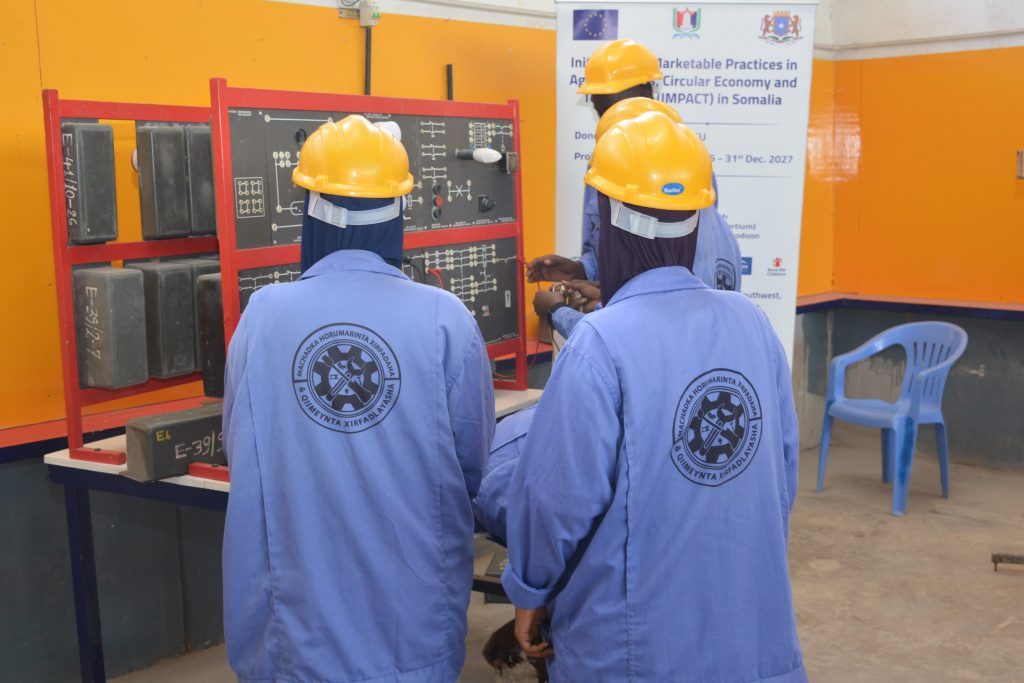
With this support in place, NISDVT gradually regained its operational strength. Today, the center is actively running eight technical departments, including plumbing, renewable energy, welding, carpentry, electrical installation, information technology, mechanical trades, and entrepreneurship. Training is delivered through a combination of theoretical lessons and hands-on practical workshops allowing students to gain real-world skills.
According to Mr. Ali Yusuf, Head of Administration at NISDVT, the transformation has been remarkable. He explained that after years of inactivity the center is now once again filled with life, with instructors actively teaching and students engaged in daily practical training. Out of the enrolled trainees, 62 students are currently active, despite some dropouts caused by socio-economic challenges.
The impact of the training is already visible beyond the classroom. Two trainees have successfully secured employment in the local market applying the skills they acquired through the program. Others are engaged in informal work and practical assignments, demonstrating that the training is relevant, practical, and aligned with labor market needs.
The IMPACT Project has also strengthened the institution’s long-term sustainability. NISDVT is now working on establishing partnerships with private sector companies to facilitate internships and on-the-job training opportunities. This initiative is expected to bridge the gap between training and employment, improving the transition of graduates into the workforce.
Reflecting on the transformation, Mr. Ali Yusuf emphasized that the IMPACT Project has not only supported students but has also restored a long-collapsed government institution. It has rebuilt confidence among staff, revitalized training systems, and repositioned NISDVT as a key contributor to Somalia’s skills development and economic recovery. With continued support the center has the potential to expand its reach and become a model TVET institution for the country.